Six Weeks at a Gate
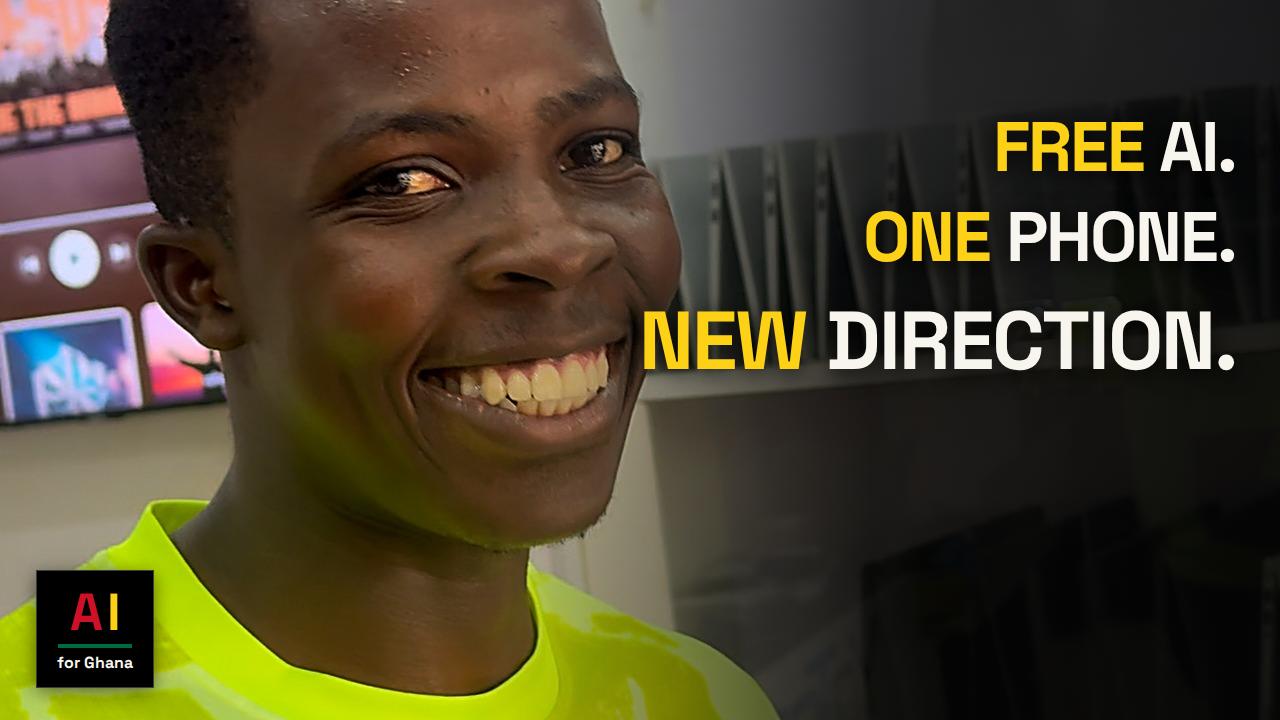
A security guard in Accra spent six weeks learning the fundamentals of cybersecurity on the phone in his pocket — and has now registered for Ghana's One Million Coders Programme. Adam Watkins of AI for Ghana tells the story of what happened when someone finally put a tool in his hand.
By Adam Watkins, AI for Ghana
Look closely at any gate in Accra — around any estate, any compound, any office block with cars lined up behind it.
There is almost always a small post beside it. A single room. A few square metres. Someone sitting inside, watching the gate, keeping the people behind it safe.
That is where two very different Ghanas meet. Right there, at the gate. And it is where the distance between them is easiest to see, if you stop long enough to look.
I drive past posts like that all the time. Most of us do. And some of us are the person sitting inside one right now.
That is where Ibrahim was when I met him.
Not idle. Not wasting time. Waiting — the way so many people wait for a door to open.
What you need to understand first
Like a great many young Ghanaians, Ibrahim came to Accra carrying more than just himself. Back in his village there is a family watching and hoping. Hoping he finds something real in this city. Hoping that whatever he builds, some of it makes its way home.
If that sounds familiar, it should. That is not only Ibrahim's story. That is a large part of Accra's story.
When we sat down together, I gave Ibrahim the same thing I give everyone who comes through AI for Ghana: a starting point. A single prompt. A first step he could take using free tools already installed on the phone in his pocket.
I want to be precise about that, because it matters. I put the tool in his hand, and I stayed in his corner when he got stuck. That is my part in this, and it is the whole of my part.
What he did with it is his.
Six weeks
Ibrahim works two security jobs. He studied in the hours between them — a free tutor on his phone, and two more free apps for daily practice: one for lessons, one for actually running the code he wrote.
He showed up on all three, every single day, and built real, working programs to prove it. Not theory. He is saving his own money towards his first laptop. Everything so far has been done on a phone.
I have worked with people from privilege, from the formal economy, people with every resource already in hand — and I do not always see this level of follow-through from them, even with far less standing between them and the finish line.
Ibrahim had less. And once he had someone in his corner, he moved harder than most.
The official step
While he kept building on his own, Ibrahim also did something formal. He registered for the One Million Coders Programme — a government initiative, free to join, running under Ghana's National AI Strategy to train Ghanaians in exactly the kind of skills he had already started teaching himself. Cybersecurity is one of the certified tracks inside it.
I want to be honest about where that stands, because his story only works if I am. The programme is still early, and nobody can promise Ibrahim a job the moment he is certified.
But it is real, it is free, and it is one more door open to him now that was not open six weeks ago. Not a finish line. A door.
Why this matters beyond one person
The scale is not even and never has been. A young man at a gate is not competing on the same footing as someone who grew up with a laptop and a good school. One conversation does not close that gap. But it does ease the thumb pressing down on the scale.
The tools were already free. They were already on his phone. What was missing was not access. What was missing was translation — somebody showing him what to do with what he already had, and staying available when it got hard.
That is the entire thesis of AI for Ghana, and Ibrahim is the clearest proof of it I have.
Where he is now
He is not a certified developer yet. He has not landed a technology job yet.
He is a young man at a gate who decided his own ability was worth more than what the world around him had led him to believe — who looked at himself and saw someone worth investing in — and who has taken the first real, official step towards proving it. For himself, and for the people back home counting on him.
He did not do it alone, and he should not have had to. None of us do this alone.